
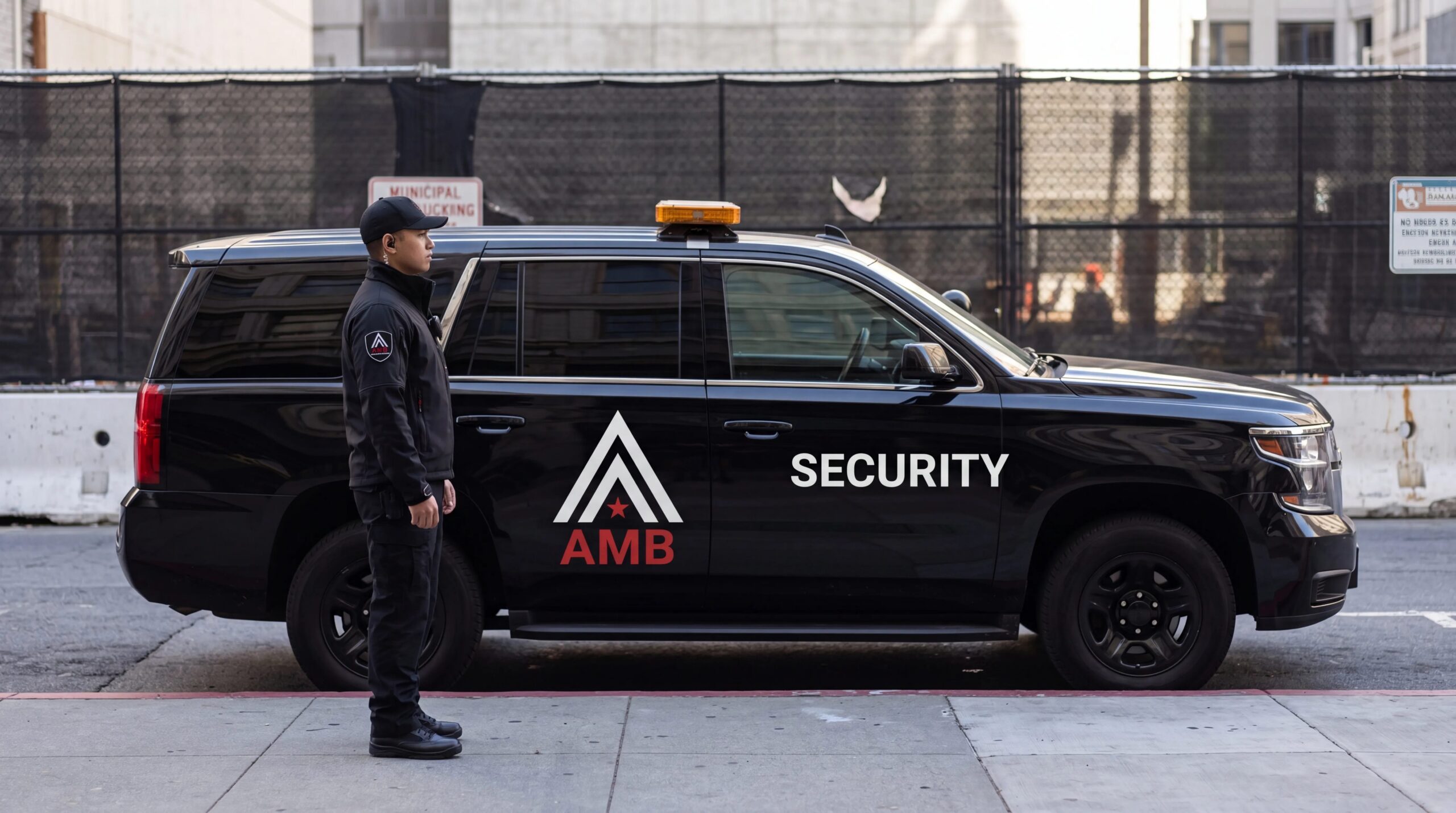
Active construction sites in San Francisco face real threats. A thorough construction security risk assessment San Francisco is vital to protect your assets. It also keeps your project on track. This assessment is a systematic review of threats to your site. It helps you find weak spots and fix them.
For local builders, theft and vandalism bring heavy losses. Copper theft, tool loss, and vandalism cost local contractors an average of $11,000 per incident. A proper construction security risk assessment San Francisco helps prevent these losses. It also keeps you compliant with your insurance policies. Most insurers require proof of site security before they pay any claim.
AMB Protective Services is a top-rated local security provider. We are locally owned and operated. We have served San Francisco since 2010 under BSIS License #16681. We carry $3,000,000 in general liability insurance. We also maintain an active workers’ compensation policy covering all officers. We are bonded for $25,000. Our team has received many 5-star reviews from San Francisco businesses. We specialize in site risk assessments built for local building projects.
This guide covers four critical security layers for your jobsite. Every layer works best when guided by a professional construction security risk assessment San Francisco:
- Perimeter barriers
- Smart lighting
- Random patrol patterns
- Detailed logs
1. How Perimeter Fencing and Access Control Prevent Theft
A six-foot temporary fence with a windscreen is only your first step. True security goes much deeper. An effective perimeter strategy focuses on controlling movement. It stops unauthorized entry. Your construction security risk assessment San Francisco will pinpoint where you need tighter access.
Focus on how people and vehicles enter your site near your business. Keep high-value assets secure within the main boundary.
- Single Entry Gate: Use only one gate for entry and exit. This layout cuts down on weak spots. Secure this gate with a heavy lock or a smart keypad. For busy sites, we station an officer at this gate. Our officers verify credentials for every person and vehicle.
- Clear Signage: Post clear signs in English and Spanish. They should read: “Authorized Personnel Only” or “No Trespassing.”
- No-Trespass Affidavit with SFPD: We help you file this with the San Francisco Police Department. It lets our officers and SFPD arrest trespassers immediately. No one has to call you at 2 AM.
- Locked Material Storage: Store tools, copper, and fuel inside locked trailers or secure cages. Do not leave them in the open. A solid construction security risk assessment San Francisco highlights these high-risk areas.
Most site thefts happen through unsecured gates or open yards. Our background-checked officers are highly trained. Every officer completes a 40-hour onboarding curriculum. They also complete monthly drills. Our team is CPR and AED certified. They enforce strict access rules on-site. We are proud of our 5-star ratings from local businesses who trust us to secure their assets.
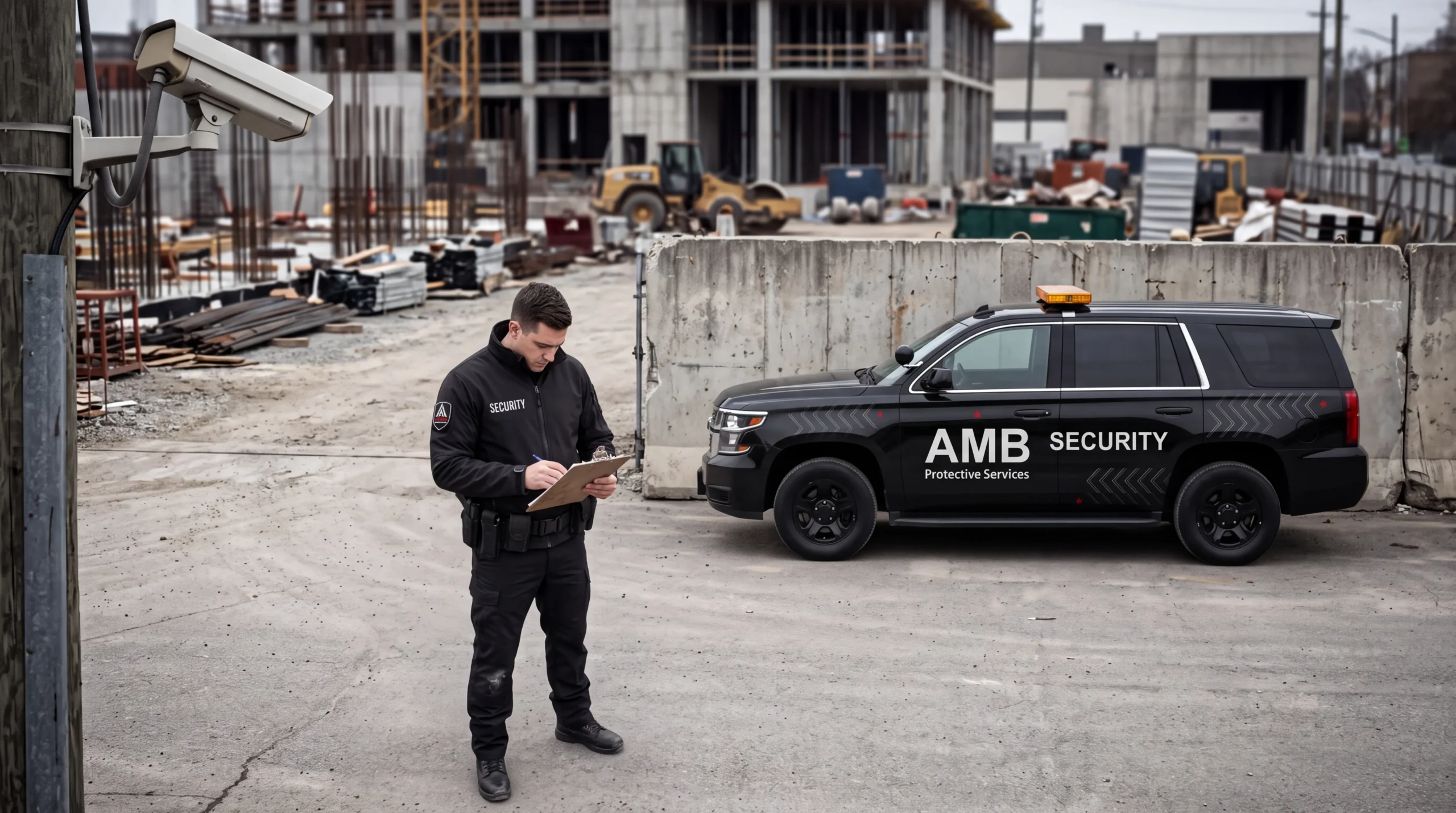
2. Setting Up an Effective Lighting Plan
Work lights help your crew build. Security lights stop intruders after hours. A great lighting plan is a core part of any construction security risk assessment San Francisco. It makes your site visible when the crew leaves at 5 PM.
To protect your site in San Francisco, focus on three lighting goals:
- Even Light Coverage: Keep all gates, tool yards, and walkways lit at a minimum of 5 lux. This level removes dark spots where thieves hide.
- Motion LED Floodlights: Place motion-sensor LED lights along the fence. Solar-powered lights are cheap and easy to set up. A sudden bright light deters most trespassers instantly.
- No Dark Corners: Walk your site at night. Find shadows between office trailers and storage bins. Place lights to eliminate these blind spots.
Good lighting is a low-cost deterrent. A small investment in solar floodlights can save you thousands of dollars. We can perform a night audit as part of your construction security risk assessment San Francisco. We will find the best spots for your lights. Our local security provider experts know how to secure properties across San Francisco.
3. Optimizing Patrol Patterns for Better Security
A predictable patrol is a bad patrol. If your guard rolls by every night at 11 PM, thieves will notice. They will just wait until the guard leaves.
We use random patrol times to keep criminals guessing. This strategy is key to any construction security risk assessment San Francisco. We serve many sectors. These include hospitals, hospitality, retail, construction, tech campuses, and dispensaries.
| Site size | Patrol visits per night | What moves the quote |
|---|---|---|
| Single building, under 0.5 acre | 4 randomised visits | Number of access points, whether materials and tools are stored on site overnight |
| Multi-phase, 0.5–2 acres | 6 randomised visits | Active phases running at once, perimeter length, lighting |
| Large yard, over 2 acres or 24/7 critical | 8 visits plus a stationary night guard | Whether the post is continuous, gate-control duties, equipment audits per shift |
Those are the levers, not a rate card. A 30-minute walk of the property is free and the written quote follows within 48 hours. Holding a written quote from another licensed California provider who walked your site? Send it with your request and we will work to match it.
Our patrol service delivers real protection:
- Random Patrols: Our BSIS-licensed guards visit at different times each night. This unpredictability stops planned break-ins. Our targeted service area is 12 San Francisco neighborhoods. These include the Financial District, SoMa, the Mission, Nob Hill, and Pacific Heights. We also cover the Marina, Castro, Hayes Valley, Mission Bay, Embarcadero, Dogpatch, and Bayview.
- Foot Inspections: Our guards do not just drive by. They get out of the vehicle. They check gates, locks, and tool trailers on foot.
- Digital Reports: Our guards use GPS tracking. They take photos of every check. You get a full activity report by 9 AM the next morning.
- Rapid Response: Our 24/7 live dispatch is run by real people. We answer every call. How fast an officer reaches you depends on the neighborhood and the hour, usually 15 to 30 minutes. That figure is our own measurement: our dispatch app logs it from the moment a request comes in to the moment an officer is recorded on site.
For large sites, we combine random patrols with a stationary officer. Our armed standing posts are quoted per assignment. All guards undergo strict training. This includes CPR and AED renewals every year. We also have TIPS-certified officers for hospitality and event posts. For fire safety, we use SFFD-compliant fire watch protocols. Our officers are fully certified for fire watch posts. We support active multi-site contracts. We offer unified dispatch and consolidated monthly reporting.
4. Why Meticulous Documentation Matters
Insurance companies in California are very strict. They inspect claims closely. Most carriers demand clear proof of security before they pay claims over $5,000.
A complete construction security risk assessment San Francisco outlines the records you need. We provide strong, audit-ready proof for your insurer:
- GPS-Stamped Logs: We provide PDF and CSV logs of every guard check.
- Photo Evidence: Officers take photos of locked gates and secure assets during rounds.
- Incident Reports: We deliver detailed incident reports by 9 AM the following day. We also file immediate reports within 4 hours of any event.
- Monthly Summaries: We compile monthly reports to help with your insurance renewals.
We have a strong prevention record. Our clients saw minimal property losses from break-ins across 2024 and 2025. In 2025, our team successfully handled over 100 documented incidents across San Francisco. We often coordinate with the SFPD to resolve issues fast. Read our client testimonials to see why we are top-rated in the region.
What to Do Tonight
Look at your site like a thief would. Use this checklist tonight:
- Check Your Gate: Is it locked with a heavy chain? Can someone easily bypass the lock?
- Walk the Site at 9 PM: Find the dark spots. Are your valuable tools visible from the street?
- Check Your Patrol Logs: Ask your current guard company for last week’s GPS logs. If they cannot send them in 24 hours, your insurance claim is at risk.
We protect local jobsites from start to finish. We offer a free 30-minute site walk. We will give you a written quote within 48 hours.
If you sign a contract, we can deploy guards on-site within 24 to 48 hours. For emergencies, we can post an emergency standing post within 2 hours of sign-off.
Contact our local team today to secure your site.
Our Contact Details
AMB Protective Services
701 Pennsylvania Ave #204, San Francisco, CA 94107
Phone: 415-990-5001
Top-rated local security provider since 2010
FAQ
What is a construction security risk assessment San Francisco?
It is a detailed review of your jobsite’s threats. We find vulnerabilities in your fences, locks, and lighting. Then, we create a custom plan to stop theft and vandalism near your business.
How much does construction site security cost in San Francisco?
Patrol costs depend on site size and visit frequency. Random patrols are quoted per site. Armed standing posts are quoted per assignment. We offer a free 30-minute site walk and a quote within 48 hours.
Which San Francisco neighborhoods do you serve?
We serve businesses across 12 San Francisco neighborhoods. This includes SoMa, the Mission, the Financial District, the Marina, Bayview, Dogpatch, and Pacific Heights. Our local dispatch team is available 24/7. Every call is answered by a real person.
How fast can AMB Protective Services deploy guards in San Francisco?
For new contracts, we can have officers on-site within 24 to 48 hours of our agreement. For emergency post-incident standing posts, we deploy within 2 hours of contract sign-off. Arrival depends on where in San Francisco you are and when, usually 15 to 30 minutes.
Related Reading from AMB
- The True Cost of a Vacant-Property Break-In in San Francisco (A single break-in on a vacant SF building runs $18,000–$47,000 fully loaded) repairs, premium impact, legal, and lost time.
- SFFD Fire Watch Compliance: What Property Managers Must Know. A failed sprinkler test or alarm system impairment can trigger an SFFD fire watch within hours. Learn when it kicks in and how our SFFD-compliant officers keep you safe.
This article is part of our coverage of construction site security in San Francisco. See our main page for details on our services and custom plans.
All officers are licensed and regulated by the California Bureau of Security and Investigative Services (BSIS). Our BSIS License is PPO #16681. Our operations follow all OSHA standards.