
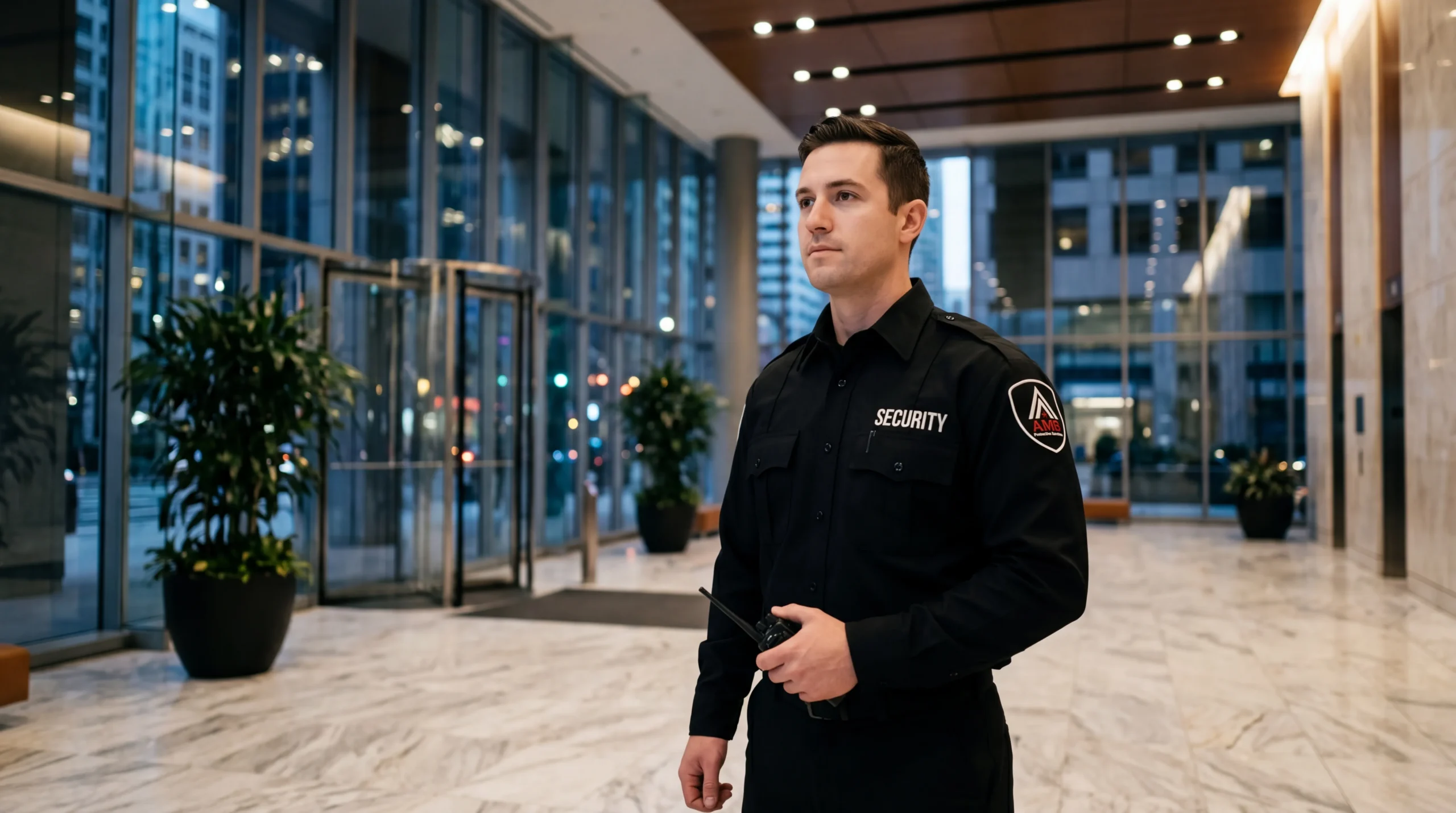
A commercial property does not fail all at once. It fails in the gaps: the ninety minutes after the last tenant leaves, the loading dock nobody watches, the cleaning crew working a floor alone, the alarm that trips at 2 a.m. and gets answered by a phone tree. A licensed officer is the thing that occupies those gaps — and, just as importantly, the thing that writes down what happened in them.
This is what that actually buys you, stated plainly and without the numbers we cannot back.
A licence is not paperwork — it is your liability position
Anyone can put a person in a uniform. What separates a security contractor from a liability transfer is what stands behind the officer. AMB Protective Services operates under California BSIS Private Patrol Operator licence #16681, active since 2010, and carries $3,000,000 in general liability insurance, a $25,000 bond, and an active workers’ compensation policy covering every officer.
That last item matters more than owners expect. An uninsured contractor’s injury on your property does not stay the contractor’s problem. Ask any provider for the licence number and the certificate of insurance before the first shift, and check the number against the state register yourself — it takes a minute.
Trained is a measurable word
Every AMB officer clears a LiveScan background check with annual re-verification, completes a 40-hour onboarding curriculum, and attends monthly drills. All officers hold current CPR and AED certification, renewed annually. TIPS-certified officers are available for hospitality and event posts where alcohol is served.
None of that is decoration. A lobby officer who can start CPR before the ambulance arrives is a different asset from a person who can only call one.
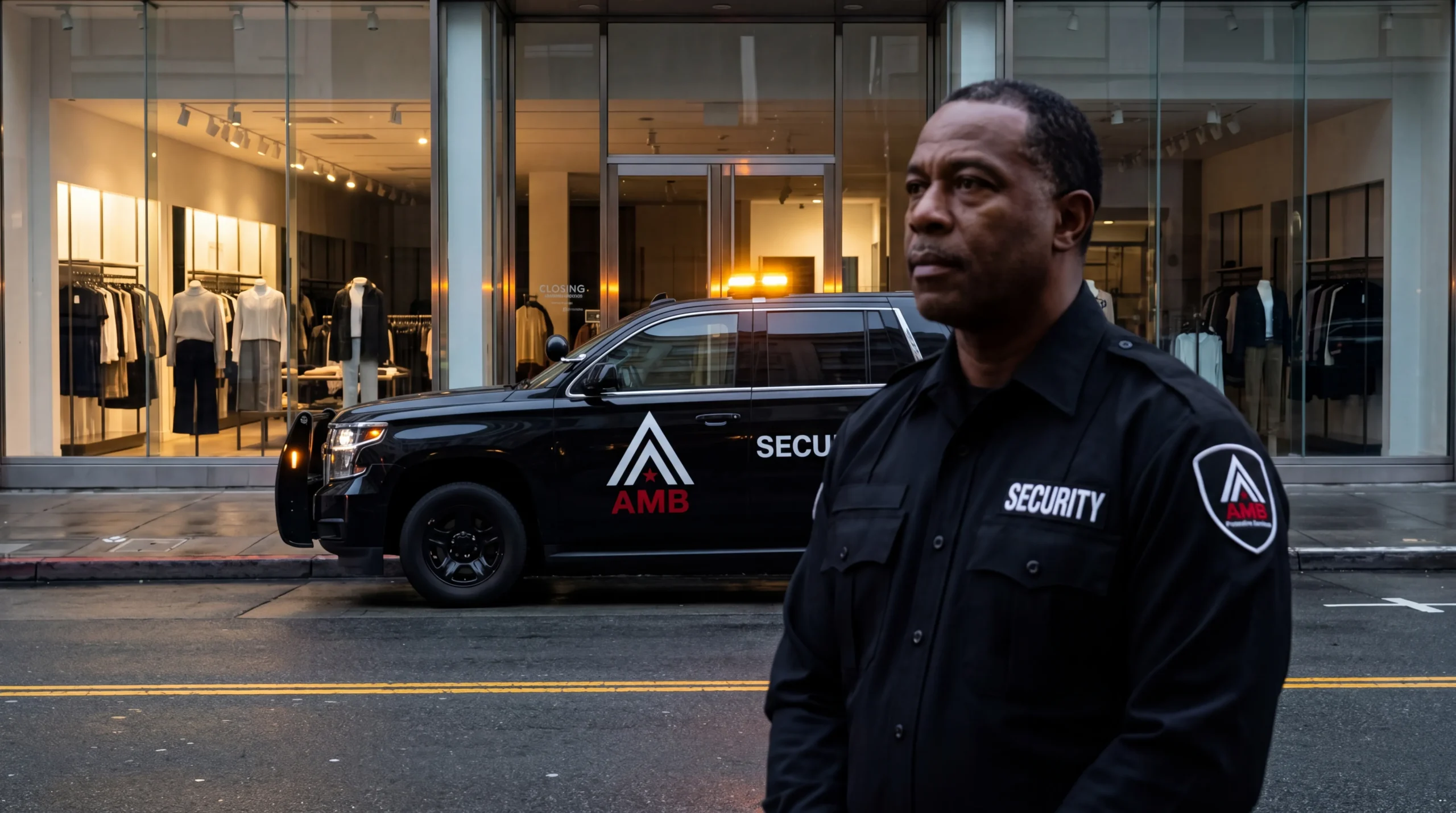
The documentation is the product
Most of what a commercial property gets out of professional security is not the moment of intervention. It is the record afterwards — the thing an insurer, a lender, a tenant or a court actually reads.
- Dash cameras on every patrol vehicle and body cameras on every officer, with footage retained for 30 days.
- A written incident report within 4 hours of an urgent event.
- A consolidated daily activity report by 9 a.m. the following morning.
- For multi-site owners, unified dispatch and consolidated monthly reporting across the portfolio.
Coverage without a record is a cost with nothing to show for it. When a tenant asks what happened on the third floor, or an adjuster asks whether the gate was checked, the answer either exists in writing or it does not.
On-site officer, mobile patrol, or both
These are different products and they are not interchangeable. An on-site officer is assigned to your property and is responsible for your property — access control, lobby presence, escorting, incident response on that site. If something happens in the building next door, that officer is not dispatched to it and is not responsible for it.
Mobile patrol works a route: units circulate between client sites through the night, make randomised checks, and break off to respond when an alarm activates. Typical response runs 15–30 minutes depending on the neighbourhood and the hour. A patrol unit is never parked outside your building waiting — anyone who tells you otherwise is describing a standing post and pricing it as patrol.
Plenty of properties end up with both: a daytime post where tenants and visitors meet the building, and overnight patrol where a fixed body would cost more than the risk justifies.
How fast a programme can start
For a new contract, officers are on site within 24–48 hours of agreement — that window includes the site walk and the officer briefing, not just the paperwork. For an emergency post-incident standing post, deployment happens within 2 hours of contract sign-off. Dispatch is staffed 24/7 and every call is answered by a person.
What it costs, and why nobody can tell you over the phone
There is no rate card, and any provider quoting your site before seeing it is guessing. The number moves with armed or unarmed coverage, property type and where it sits in the city, hours and shift pattern, site-specific requirements such as access control or medical training, and contract length. Shifts start at a four-hour minimum; contract length is agreed per site.
A 30-minute walk of the property is free, and the written quote follows within 48 hours. If you already hold a written quote from another licensed California provider who walked your site, send it with your request and we will work to match it.
Five questions worth asking any provider
- What is your BSIS PPO number, and may I check it on the state register?
- What are your liability, bond and workers’ compensation limits?
- What does the written report look like, and when do I get it?
- Is camera footage recorded, and how long is it kept?
- Is the officer assigned to my site, or shared across a route?
If a provider hesitates on any of the five, that is the answer.
Getting a number for your property
AMB Protective Services runs licensed guard and patrol coverage across San Francisco from 701 Pennsylvania Ave, Suite #204. Call (415) 990-5001 — a person answers — or request a site assessment. The walk-through is free and the written quote follows within 48 hours.